Mineral Fiber Ceiling Tile for Hospitals: What Makes a Ceiling Suitable for Healthcare Environments?
Mineral Fiber Ceiling Tile for Hospitals: What Makes a Ceiling Suitable for Healthcare Environments?
Hospitals face moisture challenges that ordinary offices rarely encounter. Frequent cleaning, changing indoor temperatures, and nearby washing or sterilization areas can affect ceiling performance. When panels absorb excessive moisture, they may deform, develop visible damage, or require premature replacement.
Choosing a Mineral Fiber Ceiling Tile means evaluating more than the initial purchase price. Healthcare buyers need to consider humidity exposure, hygiene, acoustic comfort, fire safety, and long-term maintenance together.
Why Do Hospitals Need Better Moisture Resistance Than Offices?
A typical office often operates under relatively stable indoor conditions. Hospitals, however, contain patient rooms, laboratories, treatment areas, bathrooms, and sterilization spaces, each with different humidity levels and cleaning routines.
The potential problem follows a clear chain:
l High humidity: Moist air and temperature fluctuations expose ceiling materials to prolonged moisture stress.
l Moisture absorption: Materials without adequate protection may absorb moisture and become less dimensionally stable.
l Material deformation: Sagging, warping, or uneven joints can affect the ceiling’s appearance and fit.
l Mold growth: Persistent dampness can create conditions that support mold growth, especially when dust and other organic material are present.
l Maintenance problems: Damaged panels may require replacement, increasing labor costs and disrupting occupied clinical areas.
Understanding mineral fiber ceiling tile moisture resistance is therefore essential when specifying ceilings for healthcare facilities. A suitably tested Mineral Fiber Ceiling Tile can help reduce moisture-related deterioration when its performance matches the room’s operating conditions.
However, humidity resistance is not waterproofing. Even high-performance panels should not be used as a substitute for repairing leaking pipes, controlling condensation, or addressing water intrusion.
How Should Buyers Evaluate Moisture Resistance?
The label “moisture resistant” does not provide enough information for procurement approval. Buyers should request documented performance data and establish whether the product meets the expected humidity conditions.
1. Check the Relative Humidity Rating
Relative humidity (RH) describes how much moisture the air contains compared with the maximum it can hold at a given temperature. A panel rated for high RH may maintain its shape better under humid conditions, but the rating should be supported by test documentation.
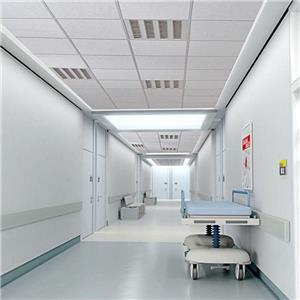
SHENGTIAN’s White Moisture-Resistant Hospital Minimalist Mineral Fiber Ceiling Tile Solution lists moisture resistance of up to 99% RH. Its product information also describes a hydrophobic treatment intended to limit moisture infiltration and support dimensional stability.
When evaluating mineral fiber ceiling tile moisture resistance, ask the supplier to clarify:
l The test method and exposure duration.
l Whether the panel maintained its shape during testing.
l The installation conditions covered by the rating.
l Any limitations stated in the warranty.
A moisture resistant mineral fiber ceiling tile should be assessed using verifiable performance data rather than a general marketing claim. Buyers should also confirm that the specified rating applies to the actual product and thickness being purchased.
2. Match the Panel to the Room’s Conditions
A mineral fiber ceiling tile for humid environments may be suitable for selected patient areas, laboratories, or spaces near bathrooms when its documented performance meets project requirements. Not every hospital room needs the same specification.
Before selecting a Mineral Fiber Ceiling Tile, consider the expected humidity, temperature fluctuations, cleaning frequency, ventilation strategy, and possibility of condensation around HVAC equipment.
Bathrooms and sterilization areas may experience more severe moisture exposure than standard patient rooms. If a ceiling will face direct water contact or intensive washdown, buyers should assess whether a different ceiling system is more appropriate.
Why Moisture Resistance Must Work With Hygiene Requirements
Moisture control and hygiene are closely related, but they are not interchangeable. A moisture-resistant surface can help maintain panel integrity, while an antimicrobial treatment may provide additional surface protection. Neither feature alone guarantees a sterile environment or replaces established infection-control procedures.
When comparing moisture resistant ceiling tiles for hospitals, check the documented surface treatment, compatibility with specified disinfectants, and cleaning limitations. A smooth, factory-finished surface may simplify routine maintenance, but buyers should verify the manufacturer's instructions rather than assume every finish tolerates every chemical.
The selected Mineral Fiber Ceiling Tile should also retain its appearance under the cleaning conditions expected in the room. Repeated exposure to unsuitable chemicals, excessive water, or abrasive cleaning can damage some finishes.
For healthcare projects, define which areas need routine wipe-down cleaning, which require more demanding procedures, and which experience elevated humidity. This makes it easier to choose a moisture resistant mineral fiber ceiling tile that suits the maintenance plan instead of relying on a broad product label.
What Other Technical Parameters Should Buyers Check?
Moisture performance is essential in selected hospital spaces, but it is only one part of a complete ceiling specification. A Mineral Fiber Ceiling Tile must also meet the project's acoustic, fire, lighting, and dimensional requirements.
Parameter | What buyers should verify | Why it matters |
Acoustic performance | NRC test data | Helps manage reverberation and background noise in patient and staff areas |
Fire performance | Applicable fire classification and supporting reports | Supports compliance with local building and healthcare requirements |
Light reflectance | Measured reflectance value | Helps maintain bright, visually comfortable interiors |
Dimensions and thickness | Available sizes and specified thickness | Supports coordination with the ceiling grid and building services |
Density and stability | Product data and relevant test evidence | Helps assess handling, installation, and suitability for the intended application |
ASTM International's ASTM E1264 classification addresses acoustical ceiling product types and includes characteristics related to acoustical performance, light reflectance, and fire safety. It does not replace separate verification of moisture-related properties. Buyers should check each requirement against the appropriate test report rather than treating one standard as proof of overall suitability.
For example, SHENGTIAN lists an NRC range of 0.55–0.70, an A1 non-combustible classification, and light reflectance of at least 85% for its hospital ceiling solution. These figures provide a starting point for comparison, but the project team should verify the supporting documentation and applicable local requirements.
A mineral fiber ceiling tile for humid environments should therefore be assessed as part of the full building specification. Strong performance in one category does not automatically mean the product satisfies every healthcare requirement.
How Can the Right Specification Reduce Maintenance Problems?
Ceiling maintenance in a hospital involves more than replacing a damaged panel. Repairs may require access restrictions, coordination with clinical teams, protection of nearby equipment, and control of dust and debris. Repeated replacement can also affect the appearance of corridors and patient rooms.
Selecting a Mineral Fiber Ceiling Tile that matches the room's humidity conditions can help reduce moisture-related deterioration when the panel is installed and maintained correctly. Buyers should also check whether individual panels can be removed for access to HVAC, electrical, and plumbing services without unnecessarily disturbing the surrounding ceiling.
For projects requiring moisture resistant ceiling tiles for hospitals, practical procurement checks include:
l Requesting test reports and installation guidance before approval.
l Confirming that the panel edges match the specified ceiling grid.
l Reviewing cleaning instructions with the facilities team.
l Planning for condensation control and prompt leak repairs.
l Keeping compatible replacement panels available for future maintenance.
These measures help make mineral fiber ceiling tile moisture resistance part of a wider maintenance strategy, rather than treating the panel itself as the only solution to moisture problems.
Choose a Ceiling Based on Evidence, Not Just the Product Label
A suitable hospital ceiling must withstand the conditions of its intended location while supporting hygiene, acoustics, fire safety, and efficient maintenance. Start by identifying the room's operating conditions, then compare documented product performance against the project specification.
SHENGTIAN's White Moisture-Resistant Hospital Minimalist Mineral Fiber Ceiling Tile Solution combines a stated moisture resistance rating of up to 99% RH with acoustic performance and a white matte finish. Before approving it or another moisture resistant mineral fiber ceiling tile, buyers should confirm the test reports, cleaning compatibility, installation requirements, and local compliance criteria.
Ultimately, the right Mineral Fiber Ceiling Tile is not simply the panel with the highest advertised humidity rating. It is the one whose verified capabilities suit the specific healthcare environment and help control avoidable maintenance costs over the life of the building.